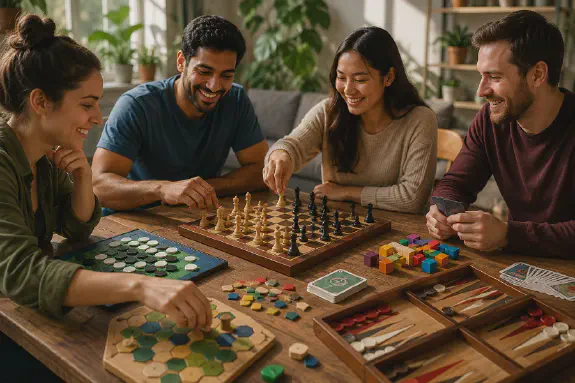
Not all games serve the same purpose, and the research increasingly bears this out. Some games genuinely appear to support cognitive health, particularly as we age, while others earn their place in a balanced life for an entirely different reason: relaxation and enjoyment in moderation. This article looks honestly at what the evidence actually shows about memory games, puzzles and crosswords, and then draws a clear, deliberate line to casino-style games, which belong in a different category altogether, valuable as entertainment rather than as cognitive training.
Crosswords: the most studied brain game of all
If any single game has earned genuine scientific credibility for supporting brain health, it is the crossword puzzle. In a 78-week study from Columbia and Duke universities, adults with mild cognitive impairment who regularly completed crossword puzzles scored better on memory tests than a comparison group playing other cognitive training games, and showed less brain shrinkage on MRI scans, a measurable, clinically meaningful outcome rather than just a subjective impression.
Research from UCLA Health has linked regular crossword completion to a delay of up to two and a half years in memory decline for adults over fifty. Notably, the benefit is not limited to pen and paper: studies suggest that digital crosswords provide comparable benefits to traditional ones, making this an easily accessible habit to build into everyday life.
Sudoku and number puzzles: strengthening working memory
Number-based puzzles like sudoku appear to offer benefits similar to word-based crosswords, but with particular emphasis on working memory, logical reasoning and concentration. A study analysing data from over 19,000 participants found that adults who regularly engaged in word and number puzzles performed better on tests of attention, reasoning and memory than those who did not.
This connects to what neuroscientists call the cognitive reserve hypothesis: the idea that mentally stimulating activity helps the brain build additional neural backup networks, making it more resilient to age-related changes and disease over time.
Jigsaw puzzles: a different kind of cognitive workout
Jigsaw puzzles offer a genuinely different, equally valuable cognitive challenge. They demand visual-spatial reasoning, patience and the ability to hold a sense of the whole picture while working on individual pieces, skills distinct from the verbal emphasis of word puzzles. One large study covering the lifestyle habits of over 9,000 people found that board games and puzzles were among the strongest predictors of reasoning skills and ranked highly for memory and verbal ability too, alongside video games.
It is worth noting an important scientific caveat here: researchers themselves acknowledge that the link between puzzles and brain health may reflect correlation rather than direct causation. Even so, regular, varied mental stimulation does appear to be associated with better cognitive function across age groups.
Memory games and their specific role
Classic memory games, matching pairs from a set of turned-over cards, directly exercise short-term memory and attention. Neural connections strengthen with repeated use in a way that genuinely resembles how muscles strengthen with exercise: the more often a specific neural pathway activates, the stronger that connection becomes over time. This is part of why a varied evening of cognitive games, combining word-based and image-based challenges, tends to offer a broader benefit than repeating just one type of puzzle.
Where the benefits of cognitive games are genuinely limited
It is important to stay realistic about these findings. Experts consistently note that the effects of brain games tend to be modest, and the strongest evidence for supporting brain health still points toward other lifestyle factors: regular physical exercise, balanced nutrition and genuine social connection. Cognitive games are a useful addition to a healthy lifestyle, but they are not the only, or necessarily the most powerful, tool available for supporting long-term cognitive health. Building healthy daily habits, including the kind of natural, herbal support for stress and sleep covered thoroughly by Health and Herbs, plays an equally important role in overall wellbeing alongside any mental exercise.
Casino games: a different category, a different reason to play
Here it is worth drawing a clear and honest line. Casino games, slots, roulette, blackjack, do not belong in the same category as crosswords or jigsaw puzzles when it comes to cognitive health. Their value does not come from training the brain or strengthening memory. It comes from something entirely different: momentary excitement, relaxation and entertainment that can serve as an enjoyable counterbalance to daily routine, provided it is enjoyed in moderation and within clear, self-imposed limits.
This distinction matters. Nobody plays a slot game to improve their working memory the way a crossword enthusiast might genuinely hope to. The value that a session at a casino such as rich bet offers is purely recreational: a light, enjoyable form of downtime, similar in spirit to watching a film or listening to music, rather than a wellness practice with measurable cognitive benefits.
Why honesty about this distinction matters
Being clear about what different games actually do for you is not just an academic point, it genuinely affects how you should approach each one. A crossword habit is worth building consistently because the evidence, while modest, points toward real, cumulative benefit over months and years. A casino session should be approached with a completely different mindset: as a bounded, occasional treat with a fixed cost, not a habit you are cultivating for its long-term value, because that value simply is not there in the same way.
Building a genuinely balanced games routine
A well-rounded approach to games recognises both categories for what they are. A few crosswords or a sudoku puzzle during the week supports genuine cognitive engagement, ideally alongside the physical activity, good sleep and social connection that the research consistently points to as the strongest overall contributors to brain health. An occasional, carefully budgeted evening of casino-style entertainment can sit alongside this as a form of relaxation, provided it is treated honestly as entertainment rather than mistaken for something with the same wellbeing value as a puzzle habit.
Setting sensible limits around recreational gaming
If casino games are part of your occasional entertainment, the healthiest approach is the same one that applies to any indulgence: decide on a fixed budget and time limit before you start, and stick to it regardless of how the session unfolds. Treat any winnings as a pleasant bonus rather than an expectation, and never let recreational gaming interfere with the genuinely beneficial habits, sleep, exercise, social connection and yes, the occasional crossword, that the evidence actually supports for long-term wellbeing.
When to seek support
If gaming ever starts to feel less like an occasional treat and more like something difficult to control, it is worth taking that seriously rather than managing it alone. Gamblers Anonymous Ireland offers free, confidential support and holds regular meetings across the country for anyone with questions about their own gambling or that of someone close to them.
Conclusion
Not every game earns its place in your routine for the same reason. Crosswords, sudoku and jigsaw puzzles carry genuine, if modest, scientific support for cognitive health, particularly when combined with other healthy habits. Casino games belong in an entirely different category: valuable purely as entertainment, best enjoyed occasionally and within clear limits, without confusing that enjoyment for a wellness practice it was never designed to be. Understanding this distinction honestly is what allows both kinds of games to have a genuinely healthy place in your life.